This critter was hanging out in a gopher hole and was not happy to have the human filling in his hideaway.
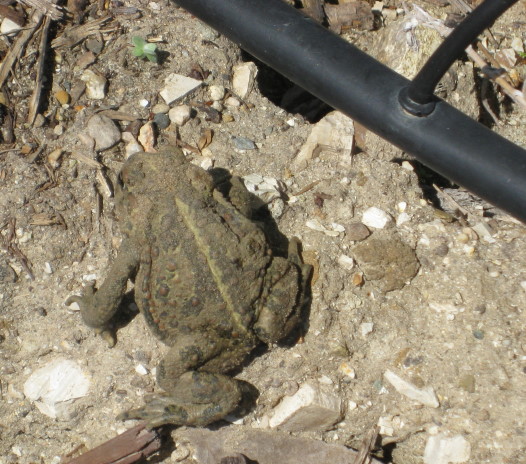

This critter was hanging out in a gopher hole and was not happy to have the human filling in his hideaway.
Another batch of garnets just posted. The rough material for these came from several countries in Africa as well as India and even the USA.

For the first time in a very long time, we received abundant rain during the winter months. The garden responded accordingly. The rain did make it hard to get the winter pruning and dormant spraying completed. The veggies also had a late start as a result.
The state of things in the veggie garden after the winter is pretty sad.

Rain found the gopher tunnels and created a number of washouts in the garden included a couple like this one that ran under the raised bed.

Another bed with the gopher tunnel issue. Plus, the corner of the garden which was not so good before, is seriously missing after the rains.

A group of peach trees, one of which is covered in spectacular double flowers.

Pear trees at one end of the orchard row produced a lot of blooms. There is a danger of fire blight because they bloom while things are still quite damp (heavy morning fog is typical.)

One of the four-in-one pluots still has a lot of flowers despite heavy dormant pruning. Many of the trees were cut back quite a lot in an effort to get them into a good shape. As a result a lot of branches that would have produced flowers and fruit were removed, but for the most part, it looks like enough remain to provide fruit this year.

This group of four plum trees has a good number of blooms.

Two of the four sweet cherries in bloom.

 I usually don’t take photos of the rough gem material. However, because I had a few questions about what it looks like before it is faceted, I did remember one day to get some pictures of parcels I had recently acquired. Now that I have cut some of those pieces, I have a group of “before” and “after” pictures of few garnets.
Obviously in these photos, the scale is not consistent. However, you can see some typical rough garnet and what was done with it. Most of the garnet rough I have encountered is similar to water worn pebbles rather than a nice geometric crystal.
 In some cases, a very fine saw may be used to split the material or remove excess material. However, the bulk of the faceting work is done by grinding off the excess to create each facet of the gem. The faceting process involves first removing flaws in the material and shaping the stone with a coarse grit. Then with a finer grit, each of the facets is cut. Often a very fine grit is used to produce a “prepolish” on the facets. Then each facet is polished with an extremely fine grit or an oxide to produce essentially a mirror finish. It is not unusual for two thirds or more of the original rough material to end up as sludge in the bottom of the splash pan of the faceting machine.
 Most faceters in the US try to do precision cutting — angles chosen are to maximize the light return and all facets properly shaped meeting its neighbors exactly according to a predetermined pattern. Another approach to faceting is what is often labeled “native cut”. In that case, the material is cut to maximize the weight of the finished stone, often at the expense of the brilliance. The facets on native cut stones also tend not to meet nicely, they are misshaped and do not line up with each other. One other major difference between “native cut” and precision cut, is the polish.
 The last storm to pass through this part of California brought lots of rain, but also serious wind. The result was that quite a few in our area spent two or three days or President’s Day weekend without electric power. Huge (non-native) eucalyptus trees were toppled over by the storm taking out power lines and poles. Smaller ones blocked neighbors’ driveways and / or broke fences. The road leading to ours was blocked for hours due to the many eucalyptus trees which had fallen across the road. For some time, the only exit from this street was to drive past a road closed sign and under a branch which went over the road to lean on the top of a power pole on the other side.
Unlike some of our neighbors, we had taken precautions for a prolonged power outage. When the house was built, the design included a way to use an external generator to power most of needed items. In addition to keeping refrigerated and frozen food items from being ruined, this is really important since we aren’t on a city water supply. It was easy enough to get by without using the electric oven for a few days, and we could have managed without the heater, but without water pressure, things would have quickly become annoying.
 After almost two and a half days, we were back on the power grid again and enjoying the quiet of the countryside without noisy generator. There is another wave of rain and wind scheduled to come through shortly, so the quiet could be short lived. Alongside the road water is running through what has dry creek throughout the drought years. There are many more large eucalyptus trees along the creek’s edges which could meet the same fate of those which disrupted things a few days ago.