Before and After

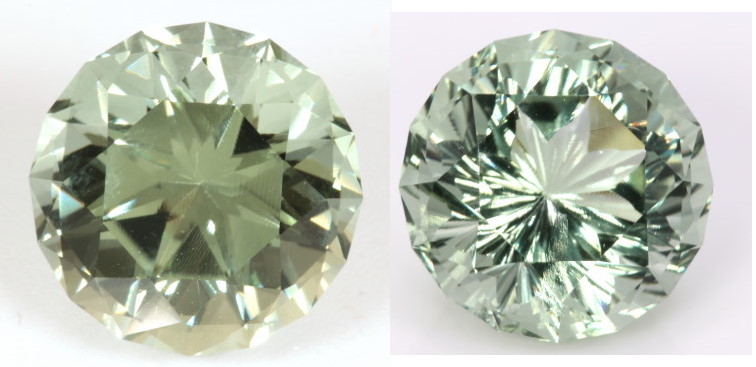
On a more positive note, I have done some experiments with adding concave facets to previously cut stones.  The first one is a round prasiolite quartz which was initially cut with all flat facets a number of years ago.  I added a row of concave facets around the culet. The stone is 15.3 mm. in diameter. When I was getting it dopped prior to cutting I managed to chip the culet so I had to cut more than planned losing .07 carats in the process.

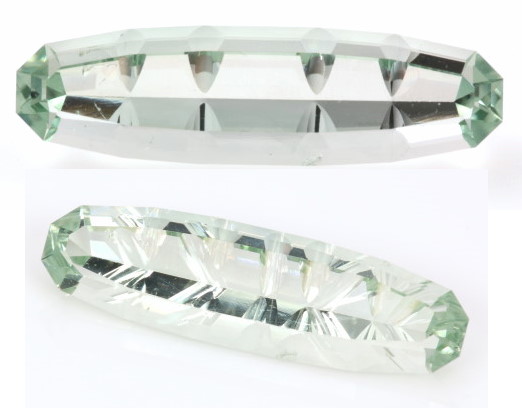
Another prasiolite already had a few concaves in the pavilion of a very long  (25.2 mm x 7.3 mm.)  oval.  The final weight was 6.97 carats having lost only .03 carats in this case.

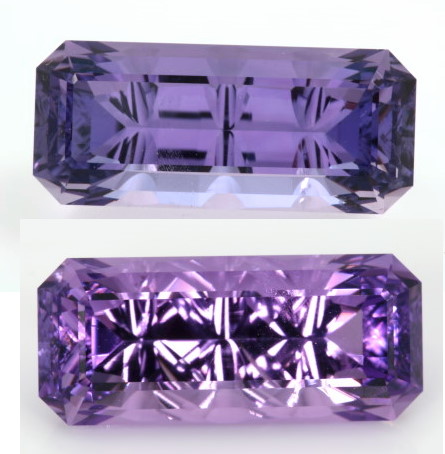
A rectangular amethyst also had some prior pavilion concave facets.  It wasn’t as boring as a plain emerald cut, but it still lacked dazzle.  After the additional concaves were added, the 21.3 x 9.2 mm. stone ended up at 13.44 carats, a loss of only .02 carats.

Both of the stones with previous pavilion concaves had been cut with my old PolyMetric OMF machine a year or so before I moved up to the Ultra Tec Fantasy machine which has much better flexibility for placing the facets.  I am still learning what combination of  stone shapes and concave facets provide the best return.


Tourmaline Trouble

In mid-November I was doing a show in Ventura during terrible weather. As a result of the storm, attendance was very low, the parking lot was a lake, the room was cold and the roof of the fairgrounds building leaked right by my space.

On the second day, things were a little better and we had someone looking at the tourmalines. I noticed that one of them looked “funny” — like maybe some lint had gotten under the glass lid of the  box. Not too many minutes later, the customer had left and my daughter called my attention to the same stone. Unfortunately, it wasn’t lint. There was an ugly fracture running across the stone.

The stone had been fine initially.  There were no “feathers” or other inclusions visible.  It had not been taken out of the box and dropped. The stone had both pink and a bit of green — not enough or in the right places to be an obvious bicolor. But it seems the stone decided it was time to split the colors.

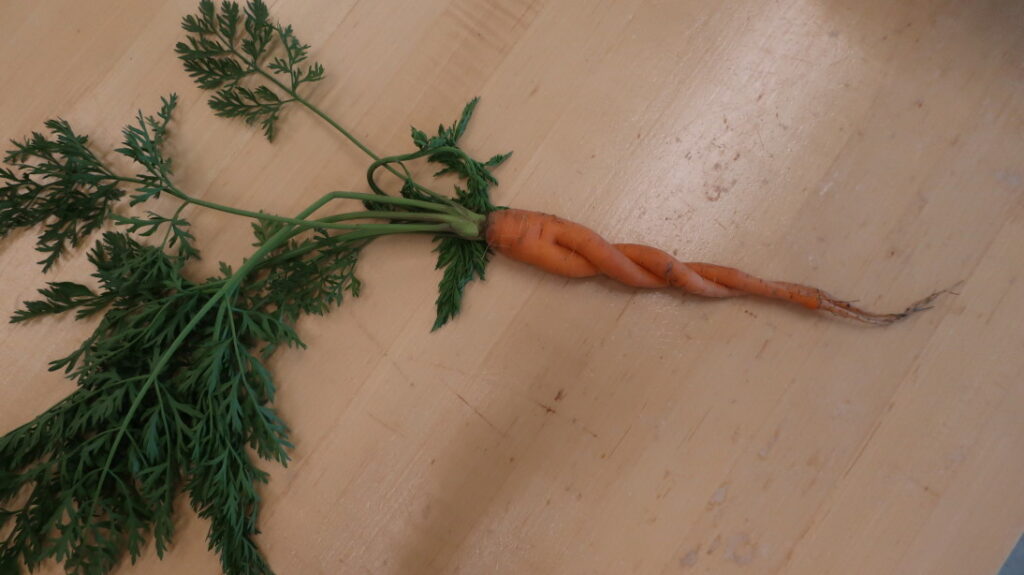
Carrot Twist

I have had lots of carrots which failed to grow nice tapered roots as shown in the seed catalogs.  But this is a new one for me.

A Visit from Big Bird

While in the kitchen this afternoon preparing some stone fruit to go into a pie for tonight’s dinner, I happened to look up and out into the garden.  One of the more unusual visitors had stopped by for a snack.  There is now one less resident lizard who was unfortunate enough to be snatched up by that big beak.

Dune

When I saw trailers for a Dune related mini-series in the fall, I thought it was time to reread the Dune series of books.  So I went online to get the right order only to find that since I last read the Dune books, their number had increased greatly — there were another nine books!  Fortunately my local library had all but one of the books I did not already have.

So more than six months later, I have finally gotten to the end of the series.  I have come across other sci-fi books which are longer, those in the Dune series are not short reads.  Most of them were over 400 pages and a few over 600.

The initial books were authored by Frank Herbert.  His son, Brian Herbert and his co-author Kevin Anderson were responsible for the later books (which tell parts of the story before, after and in between the original six books.) The writing style between the two was significant.  After this re-reading, I am totally puzzled why Dune was such a big hit.  Page after page is a character thinking or talking about what they are thinking.  It often felt like the Frank Herbert was pushing a philosophy of some sort on his readers.  The other books stick to more normal story-telling principles. With one exception — it seemed like they were writing for a multi-year TV series.  Books didn’t really end with a conclusion, but left the reader hanging for the next book / season.

As I recall from my schooling, fiction often requires a “suspension of disbelief”.  Sci-fi tends to rely heavily on that.  But some of the Dune stories and themes seriously pushed my abilities in that respect.  For instance, the imperial family, the Corrinos, had been in charge of the empire for 10,000 years.  Seriously?  With all the palace intrigue along with normal issues of hereditary rule, that is a bit much to swallow.  And I do not understand how a society with advanced space travel and related tech would be so inclined to no tech for just about everything else.  Even allowing for their fear of machine intelligence which had once enslaved them, the extremes and inconsistencies were awkward at best.  (And I do not understand why the machines would want a bunch of unruly organic human slaves when they also had the ability to have well behaved machine robots.)

Another direction I found my thoughts going I as read through the Dune series was the “compare and contrast” assignments from long ago classwork.  So compare and contrast the Dune empire with that of Asimov’s Foundation and Empire series or else with the Empire of Star Wars.  (And what is with the need for imperial government in a future society???)