
Before and After

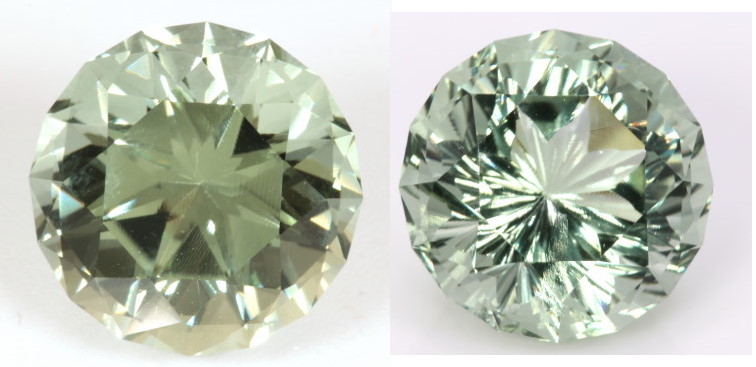
On a more positive note, I have done some experiments with adding concave facets to previously cut stones.  The first one is a round prasiolite quartz which was initially cut with all flat facets a number of years ago.  I added a row of concave facets around the culet. The stone is 15.3 mm. in diameter. When I was getting it dopped prior to cutting I managed to chip the culet so I had to cut more than planned losing .07 carats in the process.
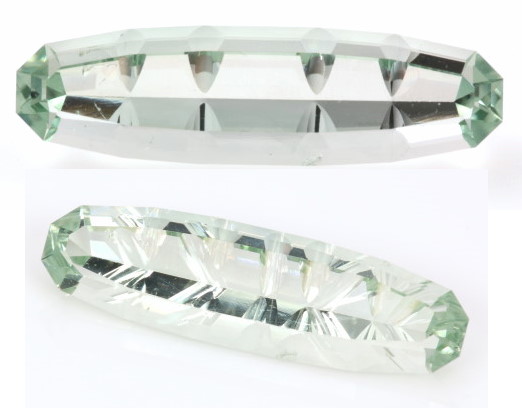
Another prasiolite already had a few concaves in the pavilion of a very long  (25.2 mm x 7.3 mm.)  oval.  The final weight was 6.97 carats having lost only .03 carats in this case.
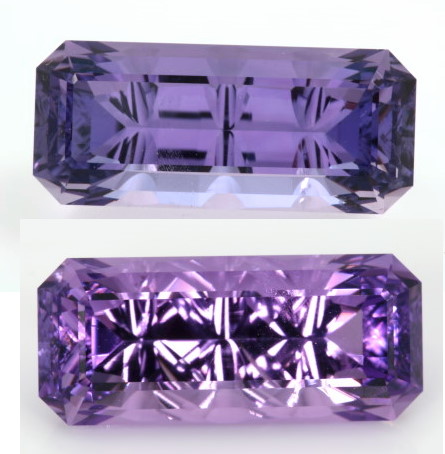
A rectangular amethyst also had some prior pavilion concave facets.  It wasn’t as boring as a plain emerald cut, but it still lacked dazzle.  After the additional concaves were added, the 21.3 x 9.2 mm. stone ended up at 13.44 carats, a loss of only .02 carats.
Both of the stones with previous pavilion concaves had been cut with my old PolyMetric OMF machine a year or so before I moved up to the Ultra Tec Fantasy machine which has much better flexibility for placing the facets.  I am still learning what combination of  stone shapes and concave facets provide the best return.


Tourmaline Trouble

In mid-November I was doing a show in Ventura during terrible weather. As a result of the storm, attendance was very low, the parking lot was a lake, the room was cold and the roof of the fairgrounds building leaked right by my space.

On the second day, things were a little better and we had someone looking at the tourmalines. I noticed that one of them looked “funny” — like maybe some lint had gotten under the glass lid of the  box. Not too many minutes later, the customer had left and my daughter called my attention to the same stone. Unfortunately, it wasn’t lint. There was an ugly fracture running across the stone.

The stone had been fine initially.  There were no “feathers” or other inclusions visible.  It had not been taken out of the box and dropped. The stone had both pink and a bit of green — not enough or in the right places to be an obvious bicolor. But it seems the stone decided it was time to split the colors.

Sunrise Surprise

I had forgotten how the difference in colors between the tourmaline C-axis with the other directions and the frequent bicolor or tricolor often created surprises in the appearance of the finished stones.

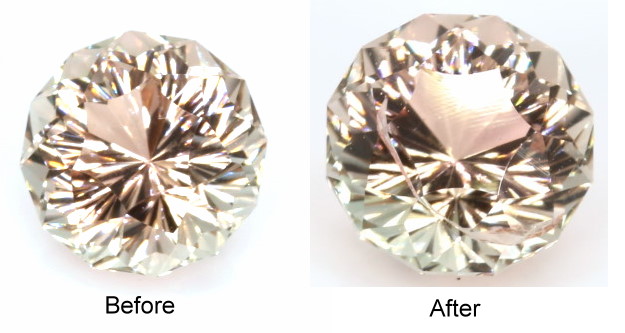
In this case, the rough showed a nice purple pink — except for the C-axis which was a lighter pink with a hint of gray brown.  I intended to cut the gem as a square brilliant, not as a step cut with “tourmaline” angles for the C-axis direction.  Thus I was prepared to see the face-up finished stone potentially a less desirable color the the purple pink of the rough.

However,  this tourmaline gave me a nice surprise.  It has orange highlights making a very pleasant combination. It reminds me of the colors of the sky that a sunrise can display on the clouds.   The finished stone is 4.95 cts.,  and 9.8mm. across with concave facets on pavilion.

Fall Back Time

This weekend we go through the ritual of turning back the clocks.  But only an hour.  If only we could turn back whole calendar pages, it would be much more useful.  My list of things to do for 2023 would have a better chance of having more items crossed off.

It seems that much of my gem related activity this year has been struggling with things I thought I had previously resolved.  Stones seemed to resist polishing.  And when it came to getting photographs, they were about a cooperative as a toddler posing for the holiday picture.

So now at the end of the year, I am finally getting around to faceting some of the tourmalines I purchased in Tucson back in February — February 2020 as well as February 2023.  So here are a few of the latest “off the dop”.

This is a little 1.06 carat chrome tourmaline (6.4 mm.) Just a lovely shade of green. (One that the digital camera liked as well.)

Next is a 2.58 carat light peachy tourmaline, 8.1 mm. across which has concave facets on both pavilion and crown.  The rough was bicolor, pink towards one end and light green at the other.  However, the green end was  not deep and was heavily included and cracked. I had thought that all of the green was being cut away in the process of getting the piece clean.  Apparently enough green was left so that there is a hint of green around the edge of the stone.

Here is another slightly darker peachy tourmaline with concave facets on both pavilion and crown. It is 3.26 carats and 8.9 mm. in diameter.  No green in this one.


And finally, a fairly traditional square green tourmaline.  It is 2.56 carats and 8.9 mm, across.  Of course I didn’t notice the lint captured on the upper facets until I was processing the photo.


Yes, More Hexagons

Before I went off February 1st for ten wonderful days in Tucson, I was trying some variations to better understand how different facet placements would impact the resulting gem.  While there are software programs that will attempt to do that for flat facets, concave facets and fantasy variations are not included.  So I set up several stones and cut them with the same flat facet pattern but differences with the fantasy machine cuts. (Besides, faceting is more fun that sitting at the keyboard.)

The first one is a 12.61 carat lemon citrine which has all of the pavilion row of facets done with the regular mandrels for concave work.  It is 14.6 mm. across, so I managed to work in more facets than I have been using in some of the smaller hexagons.


Using that same flat facet arrangement, I did two somewhat smaller amethysts.  For one, a 6.60 carat, 12.8 mm. stone when done, I used a rounded fantasy wheel and made some small curved cuts.  These added some “lights” which seem to be inside the stone.


On the other amethyst, which finished at 5.65 carats, 11.2 mm., I added a lot more of these compound concave “facets”.  It looks like the stone is full of glitter.


For a totally different variation, after returning from Tucson, I tried something along the lines of the demonstration done at the USFG seminar on Fantasy cutting.  For this one, which is 5.40 carats and 11.0 mm. across,  I used a slitter and cut grooves from the culet most of the length of the corner facets.  These were left unpolished and they are reflected by the other facets to give the appearance of having many more grooves than were actually created.